After a summer filled with conferences and a crazy move (we moved and had exactly one week to find a home, I don’t recommend this), I am excited to get to work in a new environment!

Juno hates road trips
I spent my summer expanding my knowledge in cryptography, arithmetic geometry, SageMath, and math education. I now have ideas to implement in classrooms and am more familiar with terms and programs my collaborators use.
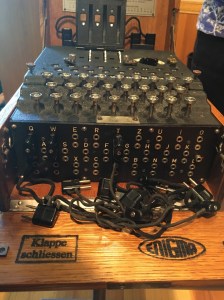
Enigma machine! We got to play with it.
MathFest was another whirlwind of information and hanging out with friends. I learned more about implementing standards based grading from Kate Owens, David Webb, and David Bressoud. You can check out Kate Owens blog full of standards based grading here: Kate Owens Blog. I think the over view here is to know what the big questions are for your course and share those with the students. Then for each of the big questions, come up with standards you think would answer those big questions. Then give your students many opportunities to demonstrate their grasp or mastery of those standards.
Ed Burger asked us to focus on the 20 year question in our teaching from now on. That is to say, what do you hope your students will remember in 20 years from now and be mindful as you walk into your classroom each day on what you are doing to address that question. He also assigned us the homework of not referring to the problems we work on in math as problems anymore. We’ll see how that goes. His final advice was to not leave a failure in the classroom hanging. Always address it, so the students have a chance to learn from them. In that way we can practice effective failure.
Ed Burger was not the only one to discuss failure at MathFest. Laura Taalman discussed the process of failure in 3d printing and in mathematical research and the importance of sharing this process with students so they can recognize that mistakes are perfectly normal to make.
Here was her flow chart:
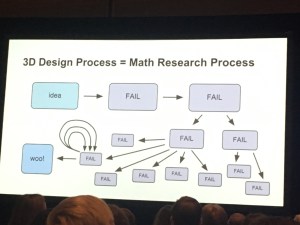
Math flow chart. The woo part is important. Someday we get there.
Here are some of her designs that she has made: Mathgrrl. Turns out you can just send designs to folks and have them print it for you.
Eugenia Cheng gave us yet another mathematics that can be interlaced to social justice. She discussed category theory and inclusion-exclusion in mathematics. I really felt like I could understand category theory after her talk. She also related the generalized form of factoring to a way to think about privilege. She looks at the number 42 and finds a way to represent the factors as a cube, which visually is way more appealing than listing all the factors in a straight line.
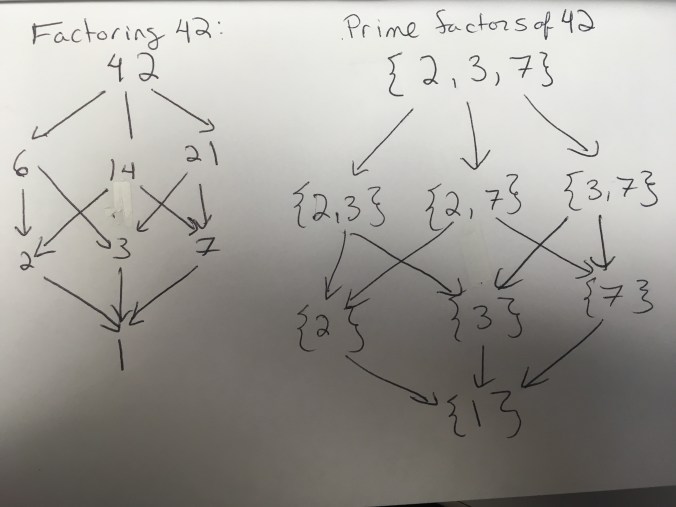
Prime factors of 42 done up as a cube. It’s hard to draw cubes for me.
And if we’re thinking about how those arrows are pointing, this diagram seems to suggest that 6>7. Abstracting this cube on the right she looks at privileges for the set of {rich, white, and male} and discusses what the implications are by drawing it as a cube.
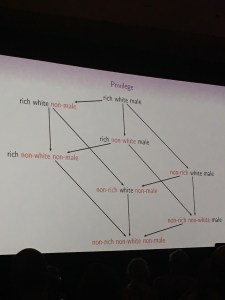
More of a rectangular prism than a cube to represent how having some privileges may lead a person to be better off than those from the same row.
The first thing she mentions about his diagram is that this demonstrates that privilege isn’t about being more privileged than everyone else in the diagram. This version of the rectangular prism helps us see that a person is more privileged than the person they are directly above. But being a rich, non-white, non-male vs being a non-rich, white male would be incomparable according to the arrows on these sets because they have completely different sets of privilege. I thought this was a good reminder of how complex privilege can be because of the intersectionality of our identities. Then it goes further to give us a mathematical means to think about our intersectional identities and how they can interplay. Here’s a version of her talk that she gave at MathFest: Inclusion-exclusion talk
There was so much more going on at Mathfest, so I’m a little overwhelmed. I will be spending the next few weeks synthesizing what I can into my courses before I forget all this useful information.
 This is what a mathematician looks like