There was an SNL skit the other day on what all conversations will sound like after quarantine. And I was about to write down at least 3 lines from that skit. “These have been crazy times,” “What a time we live in,” etc. Boy does that skit make me feel seen. The pandemic has been the main thing on my mind for over a year now, and unsurprising this impacted my list of topics for small talk. So, dear readers, how was quarantine for you all? For me, it wasn’t the worst and my household is all vaccinated now. So I think that means if things continue to get better we’ll actually be in person in the fall. The fact that there is very little I can control in this situation does mess with me, especially when I read about India’s Covid numbers that keep going up.
Online Teaching
Consistency was really key in making this work. Consistency and the large volume of instructional videos to choose from to share with my students on how to do things like use Teams for class or navigate Canvas. My campus put together a Teams group on technology which held several workshops over the summer leading up to the fall, then we had the messenger to quickly @ the whole group when we had a question on how to make something work better.
I’ll share with you some of the great tools that were discovered that I will likely continue to use even once we are in person because I think it really changed either accessibility or it started to teach a skill that most of my students hadn’t developed.
- Perusall! This is the greatest program since sliced bread. It’s integrated into Canvas (and other LMS’s), so it will pass back grades and it runs an algorithm that autogrades your students readings and comments. There is a little work in setting it up the first time, but once it’s set up it was smooth sailing. In this program, I would upload a reading and students would read it on Perusall, leaving questions and comments to their peers. After a few demonstrations on what a “good” comment looked like, several of my students really took to it and used it as a means to ask questions or answer each others questions. Often they would leave screenshots explaining how to do something, or share a notable example they had come up with that helped them understand the concept (practicing ye old asset based learning). Then Perusall would autograde it all using an algorithm that measures how “good” the comment is, how long they spent on the reading, and a few other things you can tweak.
Students can game the system, since it does run an algorithm and some students do complain because reading now took them longer (or they actually had to do the reading whereas they had gotten away in the past on skipping this part). But their complaints weren’t convincing me to stop using this tool. The only real concern I had was for students with migraine and other disabilities that made it hard to use the online tool to do the reading. So I did open the class to just doing the reading from the physical copy of the book. I did not create any means of checking that they did, I only used the honor code. That and if they didn’t do the reading the impact often showed up in their follow up work.
The reason why I want to stick with this is this is the first tool I’ve encountered where I can start to teach students what it means to read a math textbook. Anecdotally, I saw a big difference in my students ability to understand the content for the class this year as compared to last year. This also gave my students a connection to each other that we were having a hard time creating in class. So, I will use again. Do approve.
As for technical things, most books we use are online texts, so getting the pdf to upload is no big deal. But for one class we have a physical book. So I used Camscanner as well as Adobe to make screen readable copies of chapters in the book and would upload them to Perusall. This allowed me to tailor readings if I wanted to add a related article or something. - Teams chat. I used Teams to teach all my courses because my college encouraged that more of us use the free tool available rather than paying for Zoom, of which we do not have a subscription. We got breakout rooms in the spring (game changer for reals). Since enough professors used Teams, my students didn’t have too much trouble using it to attend classes. The permanence of the chat and the ability for a recorded captioned video to just appear in the chat after class were super convenient. Students did have lots of trouble getting Teams to share their screen though, I didn’t have too much trouble with that (though it does get finicky sometimes and not show all my options on which screen to share). Teams chat though, this really helped me so much. I learned from Taking Stem Online seminar about a technique “3-2-1 Go.” The premise is that you ask your students and interesting question, and everyone commits to an answer in the chat, but no one presses enter till you give the cue. This is similar to doing the multiple choice polling in class or the 2 minute papers. After an allotted time you have everyone hit enter, then you can choose different students to talk about their answers. It’s a quick way to measure misunderstanding, and it encourages people to participate since you can even leave a ???? as your answer. The emojis were also very helpful with this method as it allowed students to “vote” on certain answers. I like that the chat gives students another way to participate and will likely be keeping the chat as part of class in the future.
- Google slides. They are accessible. Also if you give students editing access they can do activities on the fly in class. We had speakers come in from the local schools demonstrate what sort of activities you can do with google slides. Then we had a secondary talk from our Technology group demonstrating activities from the STEM courses that worked well. I decided to write all my stats slides in google (I wasn’t ready yet to move abstract from Beamer). I was able to include activities in the slides where students would drag post it notes onto the slide and do their best to answer the question. This was different from 3-2-1 go because many of the answers needed more time and space, and their was more anonymity which encouraged my students who were scared of being wrong to participate more. Being able to edit slides on the fly helped a lot with typos and emphasizing certain topics to students. I will try to transition more of my slides to google as I get time. Some classes are easier than others to do this, because there are lots of math symbols I have no idea how to type in word.
- Google jamboards. Linked is an example of an activity I did in class using jamboards (it’s an activity I stole from a colleage). My students really liked these. I make each slide with one copy of the activity on it, then have students answer the questions on their slide. If they finish early, they can read other peoples slides and leave notes. This was a great tool if I needed students to draw things (like shading p values), which was not really something that’s easily done in google slides. My students said this was one aspect they really enjoyed, and I think I might keep this as it’s more likely to stay in their notes than if we did a physical version of these activities. Also, it takes less prep than making sure I have all the things printed for each group.
I primarily used empty jamboards for my abstract students to share their math. I would share the questions in my slides, then have my class work together in the jamboards. I wish it was easier to write in jamboards, but it worked okay for my students. It did make it easier to refer back to notes when we’d move on and need a tool we’d created earlier. It was also a great resource to point to proofs I’d written in their as examples of what a proof structure could look like. - Mit creation board. I didn’t know about this thing until midsemester. I really think I might have replaced jamboards with this if I’d known about it sooner. The downside is that I find it hard to navigate if I scroll away from something I’ve been working on. But the upside is that if you have a tablet of some sort (even the drawing tablet), then it’s easy to write on the screen. Jamboards doesn’t update fast enough to use a drawing tablet to write on the screen, so bummer. I used this when students needed me to work out an example and it would take me a bit of writing to explain. So I often used this in class, research, and office hours. I used to use one note, but it’s easier to use something in a browser because I can switch back and forth between their assignment (in Canvas) or reading (in Perusall) to point at things I want them to notice.
- Zoom annotate button. This is the best button.Have you ever pointed at your screen referring to something while talking to someone on zoom? I do that every class. When anyone shares their screen, you can draw on it. Using the annotate button, I can click a little arrow and point at what I’m looking at for everyone to see, even if I’m not the one sharing my screen. I want this for Teams since my school doesn’t have zoom. If I had this tool, having students ask questions would be even easier. But I didn’t use zoom for teaching. This did however make it way easier to edit a paper as a group and would highly recommend zoom as a research tool if you’re not already using it.
So yeah, not all bad. Like many of you, many of my students chose to keep their cameras off. So it did often feel like I was speaking into the void. Perusall, 3-2-1 gos and interactive slides really helped with the void speaking though, so I didn’t always feel like I was all alone. But I usually did feel like I had to be the energy in the room, so that was pretty draining (to be fair, I’ve had in person classes where I had to do the same, so maybe it’s not a camera thing?). I did try to share with my students reasons to keep their cameras on (I’m not big on making something like that mandatory), but my students still opted for cameras off. Not that I blame them, how many faculty meetings did I attend with my camera off?
Speaking of online meetings, I really really hope they keep the chat feature when we return to “normal.” I actually could participate because the chat was there. I stutter too much if I have to speak in person on the fly and thus have a very hard time expressing myself and sharing my feelings on important faculty topics. But the chat made it super easy to compose my thoughts and questions. Even my more “trivial” questions would get answered (which helps a lot with my understanding of the bigger picture).
Ungrading (and other work for classroom inclusivity)
So this and “asset-based learning” are my pedagogy buzzwords of the year. (Last year was “Culturally relevant pedagogy” which I do think I did a good job starting to implement). I think this article talks a bit about what ungrading is. Inside higher ed won’t let me read articles without making an account, so I could only skim before it locked me out. My colleague gave a presentation on this right before classes started in the fall, and in true Bianca fashion I was like “Why not? Let’s revamp my syllabus the day before classes start and see how this works.”
The basic idea here is that students should have a voice in their grading, and that as “objective” as traditional grading looks, it’s really not. In fact, it’s kind of weird when you start assigning percentages to all the different pieces of meat, I mean assignments. So how did I do this in practice? Badly and yet not too bad.
Step 1: On the first day have students discuss what grades are for.
Step 2: On the first assignment (can be begun during first days class) have students create a shared document on what they think a “fair” rubric should be for the final grade in class. Have them reflect on what they discussed about grades and their purpose to help them reflect that in the rubric. I do highly recommend to start designing the rubric in class, because students new to this system were not great at doing this for homework.
Step 3: Grade all assignments using the standards based “ERMN” scale and allow revisions of work.
Step 4: Profit. No wait, I had students write a letter due after the last day of classes about what they learned in the class, what questions they still had and use evidence from the course and the rubric to decide what grade they think they earned. Some students are very bad at this, so contact them and have an in person meeting about their grade.
In the future, I will rephrase my contacting them from “I disagree” to “I believe you forgot to account for this evidence. If we include this, do you still think you got blah as a grade?” Alternatively I can do what my colleagues do: Individual meetings with all students during the last week of classes to decide grades. Just a heads up, we don’t have a finals week.
Having it due after the last day of classes isn’t great. Also having to contact students after the last day of classes to have one on one meetings about how they ignored most of their evidence in their grades is also awkward. But the only way to move up the timeline is to have everything done the week before classes end. I am in a conundrum here because I do like the letters. I think it’s the opportunity to synthesize what you’ve learned and really think back on the class and your efforts. Since my students rarely have a final, this is really one of the few tools for synthesizing all the material at once that I have other than my final projects. But many many of the letters are really good, they act as a means for me to hear what went well in the course and what did not. They also help me combat imposter syndrome right at the get go by having students acknowledge their successes as much as their failures. A student that prefers a traditional grading system will do fine in this system, though they may stress about it since they can’t see the Canvas course summary grade, which is never right anyway unless you’re super pro on setting up canvas. A student that does badly in a traditional system will have a chance to shine in this system because they’ll be able to share with you things that aren’t gradeable. Like participation in study groups, taking leadership roles in the classroom discussions, going above and beyond in their reading to help their peers, or going above and beyond in the project because they were passionate about the topic. So, I will do this again, I just need to brainstorm how to make it work smoother, maybe they can evaluate themselves at the midterm for practice….
Other things! I used websites like mathematically gifted and black, Lathisms, 500 queer scientist, Indigenous mathematicians, and SACNAS biography project to create weekly profiles of mathematicians of different backgrounds. I used these to present the person and if they had a particular quote that would encourage my students in some way, I included that as well. I also used this as a tool to talk about different fields of math, REUs, different types of positions in mathematics, etc. My students of color really liked this, and one left a cheer in the chat as I featured someone with a shared background to him.
I also used the first 10 minutes of every class to have students share a silly answer to a silly check in question. I asked things like “If you were on a deserted island and could only eat one food, what would you eat?”, “What is your go-to karaoke song” or less silly “What’s motivates you at school, what demotivates you?” I used websites like this to come up with questions. Several students let me know that they enjoyed this as it let them know a little more about the peers they weren’t seeing, they also liked hearing my answers to these questions. So they all know my go to karaoke song (Hey Big Spender) and that I’m a super fan of fantasy books.
One thing that I did this year that I wasn’t sure I’d want to do is play songs during their 5 minute break in class. I tailored the songs based on their go to karaoke songs, and then later I requested songs through their midterm evaluation. I also played songs that my peers liked when I was younger and some students really enjoyed this. It was mostly a means for me to tell when their break was about over, and an excuse to hear what kids are listening to these days =p
Finally, I really liked the adaptations I did to the final proof portfolio in abstract and discrete, and also making the final project in stats social justice based. The stats project is a fun challenge because students get to find out just how hard it is to find data, clean data, and then choose the right test for the situation. Suddenly the conditions we’ve checked all year really matter because you have a random data set that might not play well with the tests.
I adapted Francis Su’s blog suggestions on final questions to the proof portfolio project my two proof based classes work on. I think I still have a ways to go to figuring out how to ask and answer the value of struggle question, but allowing my students the freedom to choose a medium hard difficulty question that interests them has really helped my students return to hard topics and understand it at a deeper level. I also adapted the final section of the portfolio to address open questions from the course. The goal isn’t to answer the question, but to explore it and do a write up of what they discovered either through working their own examples or reading what others have done. This was easier in discrete as so much of the course leads to open questions (open in my class and usually open in the math community as well), and a bit harder in abstract since my students usually didn’t have a big question they were still wrestling with. But my abstract students still found interesting topics to explore and write about even without a list of open questions created over the course of the semester. One found a connection between chemistry and groups in abstract that I didn’t know about. That was neat.
So, one thing I did almost every class is repeat that mistakes are welcome and that questions are even more welcome as this course is for you and you set the pace of the class. I think this helped students be more open to making mistakes in front of me and asking more questions, at least at the beginning of the semester. All bets are off after the midterms. On my end, I was very open when I didn’t understand a topic or if I made a mistake, but this takes a fine balance. I didn’t apologize for mistakes, I just made it clear “Hey I made one because no one is perfect. Here is the correction. See it’s okay to make mistakes because look at we learned from that.” This is an important balance to strike because as a young queer Latina admitting that you’re imperfect will likely mean you’ve lost the student buy-in and that makes the course 10 times harder to teach. Or maybe 100… It is very very helpful that I have several colleagues implementing similar pedagogical strategies as me. So these techniques aren’t just from the one women of color in the department. So if you’re a campus thinking about what you can do to support your BIPOC faculty, maybe make sure your classes are implementing similar pedagogical techniques so it’s easier for faculty to get student buy-in. It’s not that everyone has to teach the same way, but if the only person in your department that is trying to create inclusivity in your department is a person of color, then you’re doing it wrong.
Research
Yo! Look at this! I have papers on arxiv! Thank you to all my magnificent collaborators for making this possible even when we’re all super busy trying to adapt all our course material to online/hybrid. Here are the papers:
- “Solving Quadratic and Cubic Diophantine Equations using 2-adic Valuation Trees“, with Eva Goedhart, Maila Brucal-Hallare, Ryan Riley, and Vaishavi Sharma. This is a paper from the project started with Eva and Maila last summer!
- “Density of Periodic Points for Lattès maps over Finite Fields” with Zoe Bell, Jasmine Camero, Karina Cho, Trevor Hyde, Chieh-Mi Lu, Rebecca Miller, and Eric Zhu. This is the paper started at women in sage at Harvey Mudd and finished by my REU students from Summer@ICERM. Trevor reframed it all and cleaned up the language and we’ll be working on submitting it as soon as my brain stops being goo.
We got a grant to continue the REUF work! I’m so happy, because the REUF group is amazing.
Now let’s gush about how amazing a workshop RNT is and why you should apply. Here’s the link to more information. RNT is the first research conference I’ve applied to that respected DEI work and wanted this to be part of the application process, and it didn’t focus on my publication record to decide on my ability to participate. Because of this it was the first workshop I went to that had such a large portion of faculty of color and faculty from undergraduate institutions participating. My group did a lot of discussion on how our research group will function because we understand that if you’re at a primarily teaching institution the time to research is minimal. We agreed that when we’d meet would be our main working time and there would be none of that guilt or apologizing for not doing anything. Everyone has also been really open to any questions, even if they seem trivial. This has really helped with my number theory background as I feel every class I’ve taken or conference I’ve been to made me feel dumb for not knowing something. Maybe that wasn’t the intent of those classes or talks, but that was the impact. One thing my collaborators have done to make it feel like questions are welcome is they always say something like “That’s a great question!” or “Yeah I had the same problem.” In this way we’ve all been learning a new area very slowly but in an environment where I feel like I can learn and make mistakes. Hopefully, this summer we’ll be able to pick up the pace and see what we can come up with in the world of coding theory. I apologize to my dear reader who contacted me about coding theory as I have had 0 time to really reflect on the things you wrote about and I’ve lost the email 😦
BUT that’s not all of why RNT was awesome. The best part was the 3(?) liberate number theory sessions. In particular, I remember the discussion on liberating conferences and liberating grants. Why is this excellent? Because every type of talk I’ve been to about being a faculty of color in STEM is about how we can mold ourselves to fit the system that doesn’t want us. These talks were about what individual actions and group actions everyone else can take to dismantle the systemic racism in academia. Some actions were simple, make sure at a conference if you’re more senior to reach out to new people and talk to them, invite them to lunch, etc. Some are harder, not all schools have a grant office so applying to these big NSF grants is just not really possible, so can we create a central hub to support more people from these schools to apply for grants? So you should apply and go to these liberate number theory sessions and participate in a research group that really helps us model what we’re trying to teach our students (It’s okay to ask questions, it’s ok to make mistakes, it’s okay to ask for what you need to be successful).
So I really need to steal this model and run a Rethinking Women in Sage next summer. Who wants to apply for a conference grant with me so we can get this going?
Synergistic activities =p
My brother painted a beautiful mural at my sister’s place. It is really stunning, but I probably shouldn’t include the full piece without his permission. 🙂

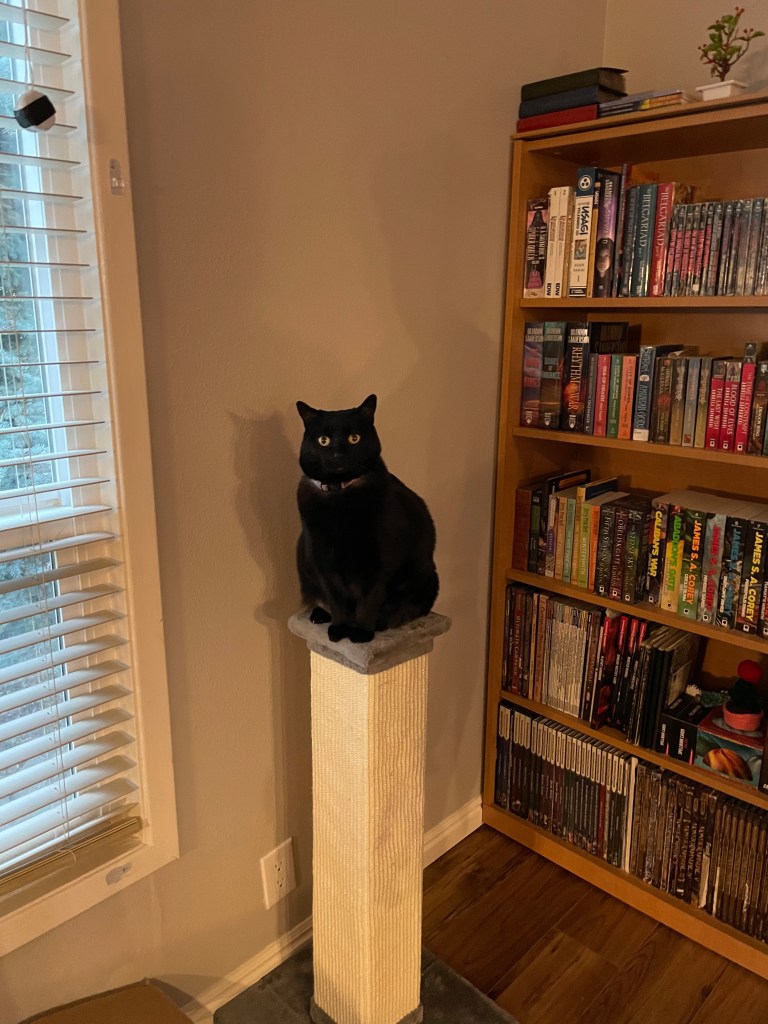
Juno continues to be pleased with teaching from home.
House care is my only hobby now. We garden a lot now which is a short way to say we are at war with the dandelions, but we are winning! We did have to submit to using chemicals, but seriously the whole lawn was just dandelions no matter what we were doing until we used some Weed and Feed.
But look at how pretty the pear tree blossoms were. The peach blossoms were also beautiful and pink. The mint is taking over the backyard. For all ye that do not know, do not plant mint in the ground. It’ll be like bamboo and take over the neighborhood. We found out our yard is full of bulbs too! It was quite a lovely spring.

 This is what a mathematician looks like