Wow, I totally wrote a summer blog post and then decided to hide it away from the internet because I don’t think it captured my thoughts well. And then I disappeared from my website, as one does, since it’s been a busy time. Also last year sucked, so I shouldn’t be too surprised that I let my yearly update disappear. I am hoping the year of the rabbit brings more hope and joy, as it’s a year I hold close to my heart.

JMM held its first in person conference this January in Boston since 2020. I was trying to be a good mentor to my research students, but at the same time I haven’t seen many of my friends since 2020, or even earlier because of this lack of in person conferences. My students gave a wonderful poster presentation and many colleagues dropped by to let me know. I wish I could have stayed longer to visit with them, but they were also doing their own thing. Here are my students in action on the PRiME webpage: Look for the second poster on the page. Sadly one student couldn’t make it so I can’t feature all three of my amazing students. By the way, as a shameless plug, if you’re an undergraduate looking for an REU, I would highly recommend PRiME. You can message me to find out more on what to expect if you’re interested.
But I digress, I hadn’t seen many of my friends (who are also my collaborators) is a very long time. We’d been meeting virtually since 2020, but had not been able to find a time that we’d have funding and felt safe enough to travel. So my collaborations were beginning to stagnate. I love doing mathematics with others, but with teaching as my main focus, it can be hard to maintain momentum. Emails would go to die in someone’s inbox quite regularly and zoom links sat untouched, despite having a regularly scheduled check in.
So, I’ve been thinking a lot about my collaborations with my friends, how I can do those better, and how I can teach my students to improve their collaborating skills. In some ways, I would say I’ve been successful with maintaining collaborations as my groups have had papers come out and get published over this time. But as you saw above, there is more that I need to do.
What I learned in professional development this summer
As part of PRiME every Friday faculty and graduate students would have professional development workshops. Several of them really helped me reconnect with my research. One in particular was hosted by Christina Edholm at Scripps College on forming research collaborations. Each workshop was 2 hours long, and for this one Dr. Edholm did a mix of knowledge drops and activities. We began with thinking about our elevator pitches on what our research is. In particular, how could you end that pitch in order to maintain the connection with the person you’re talking to. I wish I had answers for you, because I’m still not sure how to do this well. I’m not good at maintaining brand new connections, as you’ll see in this post most likely.
I really like that she took the time to acknowledge imposter syndrome in this moment and gave us some tips. Often times my collaborations are disrupted when my imposter syndrome and my anxiety meet and my brain is unable to process new information. So I try to keep her’s and others’ tips in mind. I’ve written out some of her bullet points here because my blurry picture wasn’t super readable. This is a mix of what she wrote and my interpretations and reminders to self:
- Don’t compare my background to others. Our degrees are different, our background doesn’t predetermine our success.
- Don’t compare my PhD to others. Many things impact our decisions on programs and time it takes to finish a PhD, it is very personal. I like that she also wrote “Publications are not everything.”
- It is always OK to ask for help. It’s ok to not know everything. Others may also be feeling lost. Supervisors should exist to guide me (so it they are judging me, or the environment is toxic, time for a new supervisor)
- Prioritize mental health. THIS IS IMPORTANT. Deciding to quit, change fields, or advisors does NOT make me a failure.
- This is from a prior workshop: If I think I have an area you need to work on, then work on it and don’t self sabotage. Give myself the time to polish that skill. That way when imposter syndrome starts popping up, I can be like “Whoa now, I know that’s not true because look at how much of my schedule was devoted to getting good at this.”
There were a few other important topics she touched on before research collaborations, but as this post is about collaborations, I’ll focus on the next part. I like that she laid out that there are many ways to take part in research, not just being the expert in the room. For example a good collaboration should probably have people doing:
- Project Manager
- Scribe
- Experts in the research area
- literature reviewer
- technical expert
- Graphic artist
- analyst
- editor.
A lot of times I get bogged down that I’m not the resident expert, but that’s not the only role in a collaboration. In fact if we only have experts, there’s a chance that the collaboration will fail as we didn’t have anyone write things down or plan our next meeting, etc. Now of course, people can wear many hats from this list, but having a good project manager could be the difference between finishing a project or letting it sit on the back burner for the rest of ever. She spoke about what each role entails. The project manager is the person who helps coordinate us and keep momentum going. Perhaps they make the zoom links, email everyone with updates or to do lists, gives deadlines, etc. The scribe is the person who writes up what we talk about and could easily transition to being the analyst who digs into the proofs we’re writing and makes sure that the details are correct. The expert in the room could be a general expert or the expert on the specific project. The literature reviewer is the one that sits the problem in the bigger context of the field (as well as the one who makes sure it’s not already solved and written up). The technical expert could be the coder or they transition to graphic artist as they are best with using Tikz for making images. And the editor makes sure we have one voice and are conveying the right amount of information. We did an activity at that point in which each of us was given a different role and were asked to solve a calc 3 problem. It was empowering to see these different roles be acknowledged as important to the whole group. I have more often than not found myself in the role of scribe or analyst, and that was why I thought I was a bad collaborator. I can only rarely contribute as a general or project expert, and that reinforces my imposter syndrome. But to see the others roles valued helped me to recognize my contributions as important.
Now that being said, authorship and ethics is weird. I’ve taken a lot of NSF ethics training on what counts as enough contribution to count as an author. I remember a few times now that these videos usually say if you’re an editor and made no other contributions, then you are not an author of the paper. So I want to keep that in mind as I work together in the future.
Some other misc tips I found in my notes from this sessions are:
- Lit review is good to do as a whole group. Share the paper and one bibtex. Then in one location (say on your projects overleaf) write a summary of each paper’s key ideas. Designate one person to find the narrative.
- Set expectations with your group.
- Be forthright about setting a role for yourself and others.
Rethinking Number Theory’s panel on collaborating
I’ve spoken on this blog about how awesome I think RNT’s design is I believe. If not, I’ll just say again I really appreciate their mission and the actions they’ve taken to support communities that are marginalized in mathematics. At JMM I had the opportunity to take 2 on giving a talk on work that resulted from RNT 1 (When JMM went virtual last year I was supposed to give a virtual talk, but as I said last year sucked and so that didn’t happen). Because I was there for my talk, I happened to see that they had a panel on how to do successful collaborations put together by other RNTers.
My collaborator was in the audience as well and we both had let our project die in 2022, so we were ready to receive some much needed advice. (I have notes written about the changes I wanted to do after the summer workshop, but I did not implement any of those changes in 2022). I do regret not taking notes as now I’m reflecting over a month later and can only pick out some of the great stuff that was said there. Some of it was similar to the prior workshop that I had attended, some felt new but it might be because I’d forgotten about the workshop until that moment. So without out much ado, here’s what I remember
How do I start a new collaboration?
There are many ways to do this. It can be structured or it can be free form. If you’re looking for structured then you’ll want to try to apply to some research communities in or related to your field. For example, AIM holds one week workshops during the year. They pay for everything and help the organizers structure the week so that everyone can be onboarded quickly and have the freedom to work on any of the research questions posed related to the workshop theme. I have loved these (there is more to the picking of the problems than I’m revealing here, but I didn’t want to go into too much detail). In number theory for identities that have been marginalized there is the WIN, WINE and RNT. For grad students and early career there are Mathematical Research Communities (MRC) and summer schools like WAM. There is also Arizona Winter School (also for number theorists, can you tell I have a niche?).
As for free form, the presenters gave examples of going out to eat with friends that ended up in great collaborations. I personally tend to ask friends if they have some input on a thing that I’m working on. If the conversation is fruitful that turns into a collaboration. If not, it’s a cool learning opportunity and a chance to gush about math with my friends. Some panelists also said there were ways to meet new people who’s work you were familiar with and strike those conversations. But to be okay if that doesn’t move forward, because sometimes people schedules or expectations just don’t mesh in that moment. I am not yet convinced I’m brave enough to do this, but several of the panelists had success stories.
How do you rekindle love lost a collaboration that died?
Jokingly, they answered invite someone new in to do the rest of the work. And then more seriously, they did recommend inviting someone new, like a student, in to revisit the project and see what excites them. They also recommended meeting in person with collaborators at the beginning of a project and at the end. Virtually works best for the in between parts. This was something I hadn’t heard before, but it’s something I want to start implementing more.
How do you have a successful collaboration?
The panelists made sure that we understood that success doesn’t necessarily mean publishing papers. They also acknowledged that papers are the currency of academia (even if that’s not a good thing), and they used this to transition to some of their main points. When you get into a collaboration, you want to make it clear what your expectations are. People are at different points in their careers and interests. So if you’re going into a collaboration and you need a paper by August because you’re on the market, maybe don’t work with the friend who doesn’t need any publications and is currently just exploring the idea because it’s fun. Or if you are going to work together, make sure you both understand what you’re hoping for in this collaboration. I realized in that moment why some of my collaborations weren’t working at all. I don’t desperately need publications and I devote most of my time to improving my teaching in any given semester. I do research because I love mathematics and I love to explore new topics, so I’m not in a huge rush at any given moment. I did not communicate this expectation well to my team. Several in our group needed the publication, and needed it soon.
Implementation in the classroom and in my research
I tried hard to model the advice I had received from the panel and the workshop while at JMM. My collaborator had been in the same panel and we immediately carved out lunch and the afternoon to finish the project we’d been sitting on for over a year. We found an open table and hopped on the spotty wifi as we read through the draft of our paper. We wordsmithed away and came out with a better written product that I’m more proud of. I hope it gets a more positive reception at the journal we sent it to. At dinner, a new collection of text popped up and I saw that my collaborators on a second project were at JMM. We set aside a few hours to start on some ideas that we hadn’t had the opportunity to play with since I had first proposed the idea via email in August.
Finally, I had my first positive math interaction at a dinner since I started this whole mathematician thing. I have always been intimidated when people talk math at conferences because I don’t hear math well and my background can be spotty. I was chatting with a good friend when she started asking me some stuff about permutations in abstract algebra. I didn’t really remember much about them besides how to work with them, but I knew what to look up to refresh on the theorems. And then as she bounced ideas off of me, I discovered I was comfortable with having her reexplain ideas and assumptions she was making until I understood them. I then carefully wrote up what we were talking about on the notebook paper another friend had given me. This helped me to identify the other holes that I wasn’t certain on. There might still be some assumptions that are wrong in the proof, as some topics we used are black boxes to me, but overall I understood the structure of how to prove this style theorem. This has given me confidence to have more of these types of conversations. It’s okay for me to ask questions, even if it does reveal that my background is lacking. My background will never get better if I don’t ask. Mostly I was trying to remind myself those really awesome panelists also had imposter syndrome and also had moments where they didn’t know things, and that’s okay.
The spring semester has begun again, and I know I need to reach out to collaborators to continue the work done at JMM. I believe I’ve done a slightly better job of laying out my expectations with folk this time around so they shouldn’t be surprised that I have once again disappeared into my teaching.
Going back in time, as I came back from my summer of awesome (PRiME was quite an uplifting experience for me, maybe I’ll spend some time posting pictures at a later date), I decided to update how I was going to teach my first years. I teach a first year learning community some years and it’s key that we help students develop the skills that will lead them to be successful. We do a lot of group and project work in my courses and in other courses. There is a lot of great work around POGIL for how to do good group work, but I have not had the chance to see what that looks like in a math class. One thing my POGIL friends tell me is that you need to have assigned roles for the students. I’ve done this before using variations of “Scribe, Spokeperson, Facilitator.” This time I integrated more of what I had learned in the workshop. A skill I thought was important to develop was identifying the roles they had in a group them explain how they fulfilled it. Looking back I should have leaned more into this and had it as a part of their final assessment of the group projects. Since they also have 3 portfolio check ins I could have had them reflect on their roles there as well. It’ll be awhile before I teach solely first years again, so I hope I remember to do this change.
I have not reintroduced this concept in the courses I’m teaching this Spring because I predominantly have older students who’ve been through a lot of well structured courses with group projects. Also, the semester started the day after flying back from JMM, so I admit I wasn’t ready to make too many more changes. I do want to be more consistent with how I do group work since working together is foundational in all of my courses. I plan on leaning more into understanding work that’s already understood like POGIL once the spring semester of service (which is how I will dub this semester) ends.
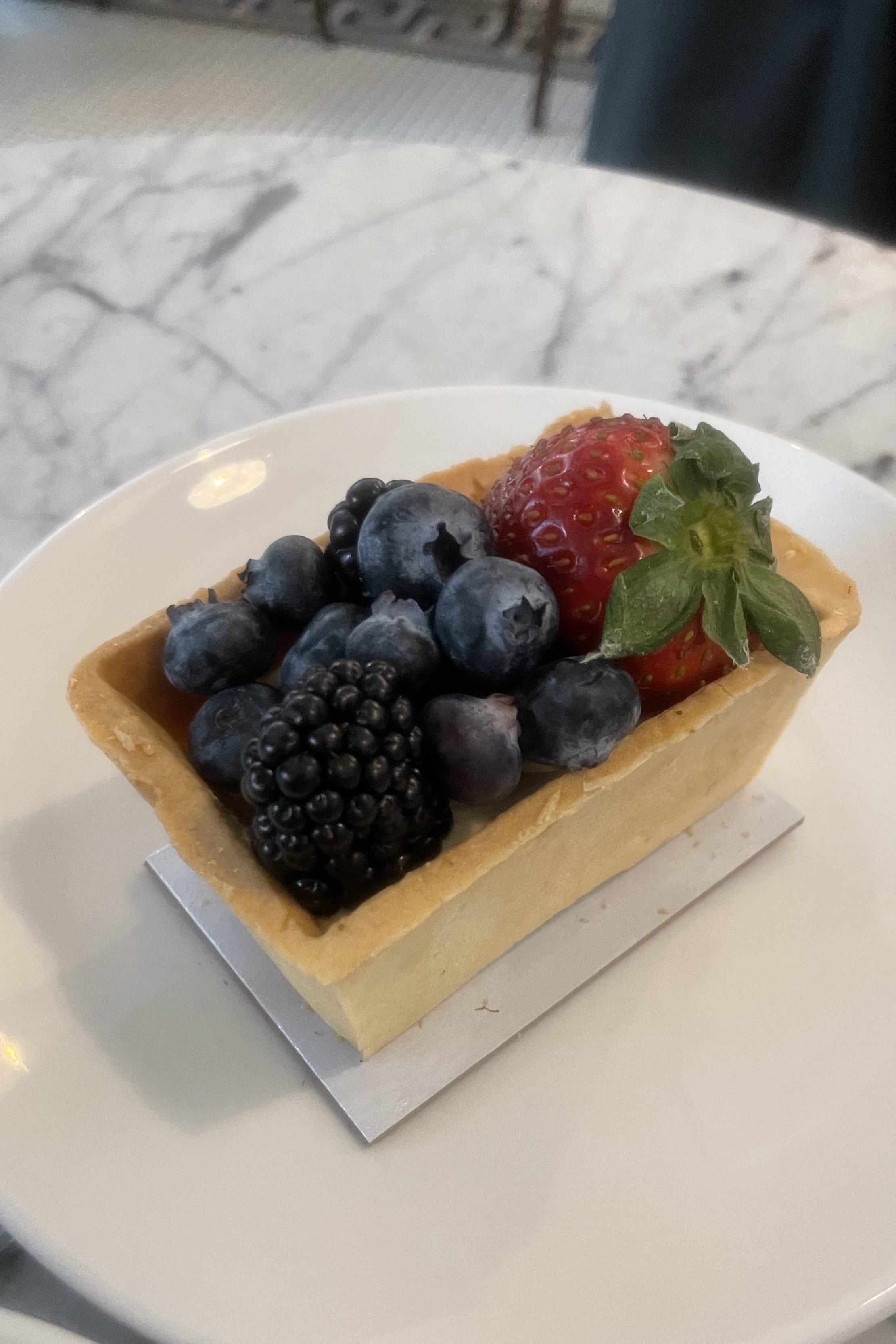
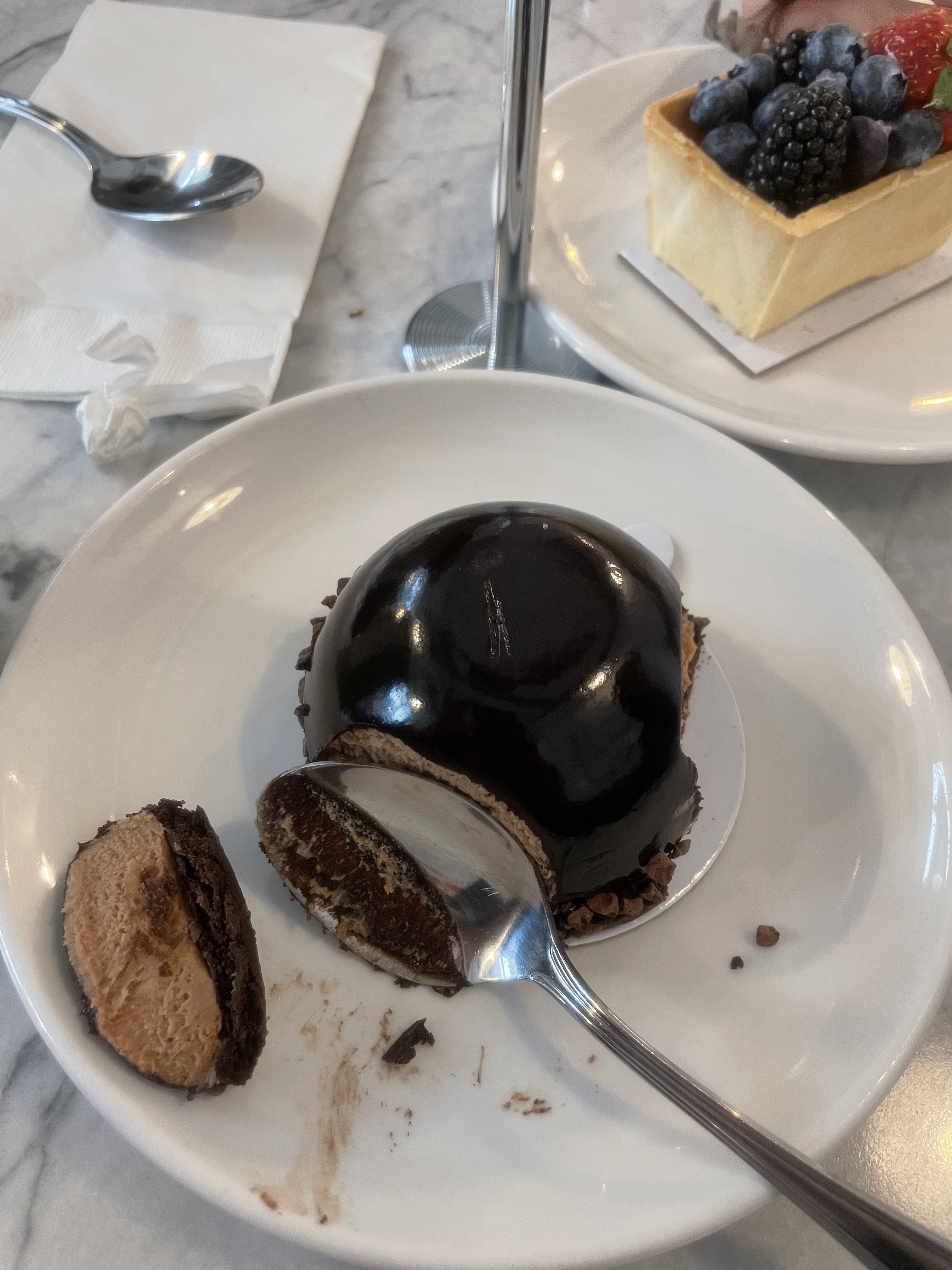
Usually I like to include a few pictures from these experiences, but as I flipped through my phone, I realize that I’ve been less likely to snap pictures of the people and events around me. So I’ll end by sharing images of two desserts I ate at Tatte, a place I highly recommend. The food here was so incredible and was definitely the best place I ate at during the conference.
 This is what a mathematician looks like