I saw a video awhile back that said the Hero’s Journey is not the only journey, as it is masculine and many women do not follow that path. In order to “become whole” a woman would need to go on a Heroine’s Journey– video in question Why Women Need Their Own Myth. Maureen Murdock thus created a journey for women: https://heroinejourneys.com/heroines-journey/. There are 10 steps according to the website (and book I suppose, but I am backlogged on books, so it will be awhile yet before I get to this one). 1) Our heroine separates herself from the feminine. Maybe it’s because she’s sees other folks demeaning women, and thus she thinks if she’s “not like other girls” then she won’t be demeaned. 2) She identifies with the masculine and begins the gathering of allies. Maybe this is gather a community that will support her on her goals as she for a path beyond her prescribed societal role, but takes on many masculine traits to do so. 3) In her trials and tribulations she faces ogres, and dragons all trying to destroy her. 4) She experiences success and she has overcome the obstacles that she faced on this path and has achieved. The website notes this is where the Hero’s journey ends, but like I said there are 6 more steps for us. These first 4 steps feel familiar as journeys for some fantasy ladies I’ve read. Arya, Sansa, Cercei, and Danaerys come to mind as their journey either stops here or they hit step 5/6 and are unable to move on either because (spoilers) they die or the show ends.
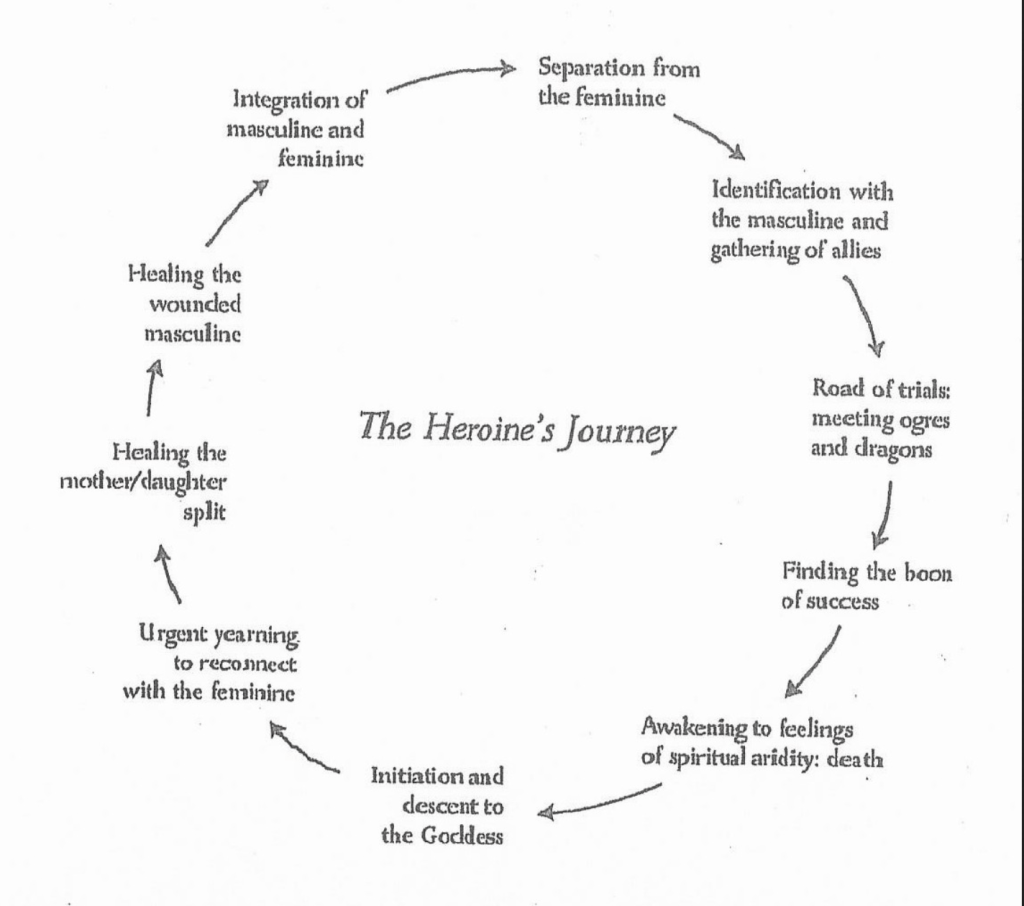
Now things change for the heroine: 5) she awakens to feeling of spirtual death. Her way of life is too limited. Her success in this path/way of life is temporary, illusory, or requires a betrayal of self-traición a uno mismo. 6) Dominant group strategies fail the heroine in a crisis she must face in her new way of life and she falls into despair (descent to the goddess). 7 and 8) The heroine works on healing her split with the feminine and can now view her new traits through new perspectives. 9 and 10) She heals the masculine approach to life within her and then integrates the feminine and masculine perspectives and becomes whole thus seeing through the binaries and has new ways to interact with the complexities of the world (which sounds like its borrowing from the indigenous ideas of Two Spirit, or in Anishnaabemowin, niizh manidoowag).
Can you tell I haven’t read the book? That doesn’t stop me from musing! While reading Gloria Anzaldúa’s Borderlands/La Frontera, I started thinking about what is this Heroine’s journey, but for Chicanas like me? Or more personally, what is my viaje de heroína Chicana? Have I finished the journey? Am I in the midst of it? What has helped me move through this circle? Then what does this mean for me as an academic?
Separación de los chicanas
I am a big fantasy fan, especially books (though these years I’m more a collector of said books than a reader, but we’re working on that). As a kid, if it wasn’t fantasy, I had no interest. And if it was romance! Ewww, no way was I touching that. Except when it was required by school, at which point I’d read the book (can’t be messing with my “smart kid” identity) and be an incredibly stubborn student who complained the whole time, but passed the tests (Lo siento mis profesores).
One memory that stands out highlighting my stubborness is my Junior year reading Sandra Cisneros’ The House on Mango Street, I had a visceral reaction to one of the opening paragraphs:
“They always told us that one day we would move into a house, a real house that would be ours for always…we’d have a basement and at least three washrooms so when we took a bath we wouldn’t have to tell everybody. Our house would be white with trees around it, a great big yard and grass growing without a fence. This was the house Papa talked about when he held a lottery ticket and this was the house Mama dreamed up in the stories she told us before we went to bed.”
I was lucky to have loving grandparents who’s small business was stable enough in a town with low housing prices. They had bought a place and offered it for my parents to rent when my sister and I were born. That way we could come home and they could have their grandbabies. I didn’t have to move from place to place growing up, always a roof over my head and mi abuela teaching me. But also, this wasn’t our house. My dad would hold that lottery ticket and talk about where we’d move to, and how things would be different, debt gone, creditors not hounding our phone every single day. My sister and I would look at floor plans for houses and dream of a house we could never have. I’d draw my dream house and think of all the trees I’d want it to have and the places I’d have to hide and read. But it was only a dream, I never believed we’d have our own home. So this opener was too much for me, I couldn’t come face to face with these feeling of a dream that couldn’t be and read about someone else who had the same conversation with their dad, and I felt the tone was telling me all was hopeless. I wanted to separate myself from this book and this Chicana identity that was full of hopeless dreams. This was long ago, but I suspect I felt my Chicana identity was holding me back and would lead me to also having shattered dreams.
Identificación con el Anglo y reunión de aliados. Y logrando el éxito
Español brought to you by the Spanish-dictionary. I am learning oh so slowly, so I can’t translate well.
1,950 mile-long open wound
                           dividing a pueblo, a culture,
                           running down the length of my body,
                                  staking fence rods in my flesh,
                                  splits me    splits me
                                         me raja     me raja
-Gloria Andzaldúa, excerpt of her poem
“¿Qué eres?” “What are you?” is a question I used to get a lot as a kid and in college. Which, if you weren’t certain, is a microaggression, so try not to use that phrasing if you’re curious about someones cultural heritage. I did answer the question, even though it irked me. Japanese-Mexican-American. I tended to emphasize the Japanese part most, and even took tons of Japanese courses in college in order to learn more about that part of my culture. When given the opportunity to learn Spanish as a kid, I opted for French. I stubbornly rejected the Mexican part of my identity, even though I don’t think I was aware that was what I was actively choosing. Since Spanish wasn’t spoken at my house, it was not something I picked up and so I continue to say “no hablo español. No entiendo” when asked. My sister is going to mess that one up for me though ’cause she keeps saying “No nintendo” in our group chat. So when watching the video on the Heroine’s journey, steps 1 and 2 really feel like what I did. I was rejecting part of my Mestiza identity in favor of the American and Japanese parts and found friendships and allies to support me on the academic journey I chose. I used to wonder what it meant to be Mexican-American. How can I have this identity and have never been apart of Mexico, not be able to speak Spanish, not understand our culture?
In graduate school, my Latina identity became more obvious. I had the physical markers I don’t typically have if I avoid the sun, and the ambiguity of who I am faded. It also was hard for me to avoid worrying that my performance now would determine whether or not my program would ever let a Latina again. I still think I’m the first Latina/Chicana PhD in math from UH Mānoa, but would love to not be if anyone knows our history more. But hey, I did graduate! So that’s Step 3 and 4 accomplished. I faced my ogres (comprehensive exams) and achieved some measure of success while also being incredibly far from my home and mi familia.
This translation of the heroines journey doesn’t apply perfectly here, as it was in undergrad and grad school that I started to embrace my Latina identity and learn more about her. (also queer identity, but embracing that one would take longer). I met other Latinas from around the world and learned more about what we shared and what we didn’t. I danced in a group that did traditional Latinx dances and even performed at a Latinx wedding through this dance group. So I was exploring what my culture meant far away from home. It was also during this time that I realized I had a lot of Latina role models who had gone on to be successful (My mom being one of them, as she had just become tenured while I was in undergrad). So that vision from my childhood of our dreams never coming true started to break, and this wrong view I had about my own heritage was being replaced with pride. SACNAS and others also helped me defeat those dragons and ogres.
Even as I stopped shying away from calling myself Latina, my actions didn’t support my identity as I chose my career over my family over and over again. Either because of lack of funding or because I felt that if I passed up opportunities I would fail. I’ve mentioned that I missed my Great Grandma’s funeral, but I also missed my mom and dad’s church wedding in favor of a conference. My great grandma always wanted to see her favorite grandbaby married by the church, so this was kind of a big deal in my culture and my family. I missed being there for my sister or brother when they needed me. I’ve grown distant from mis primos that I grew up with. You might say, I made my choice, but at the time I also felt there was no choice. If I didn’t do things that academia wanted of me when it did, then I wasn’t good enough and should be kicked out. If I was kicked out, what if that meant they’d think that all Latinas can’t hack it? Would my failure be seen as personal or representative? Maybe that’s the anxiety speaking, but given how people behaved around me I wasn’t exactly assured that it was only my anxiety.
Despierta con la sensación de muerte espiritual
My friend once asked us how we were healing the rift in us between wanting to do theoretical math and wanting to change the world for the better? Or beyond my identity as an advocate, how do I heal this split in my identity and culture that I created in pursuing an academic degree in the ivory tower? My research, writing, and presentation is always cleaned up for academics. My friends laugh when I say a sentence in three languages instead of just English, so I practiced hard to say the English versions of things. Avocado, hair tie, lotion, money, I don’t understand, etc. Admittedly my vocabulary in other languages in garbage, but my family switches languages mid-sentence all the time and so I really did not know that what I was saying wasn’t English, or it was slang in Spanish, or Japanese. Anzaldúa embraces this melding of languages and I see my family in her books being talked about in a positive light. Their language is not sucio, it is an evolution of being Chicanx.
I live a 14 hour drive from my family (can’t drive) and this is the closest I’ve gotten to be to them in 20 years. Mi abuelos, tío, y tías no comprendo my degree. They laugh when I can’t calculate on a whim, or I use slang. “Mira, the PhD.” I see talks at SACNAS about finding ways to reconnect with our community and bringing our knowledge together from our culture and our education. How can I reconnect with my family and my culture (while leaving behind the bad parts of it, like the rampant sexism) when I live so far from mi frontera. Pero, when Anzaldúa spoke of the Fear of Going Home, I felt that. I know I’m too stubborn to conform to who I’m supposed to be in our culture, but also I know I have a bit of a facade when I’m home. So even when I am home, there is a divide that I’m learning to bridge.
The math I do is not enough to heal me or build connections, my job isolates me. After hitting midcareer, I’ve felt lost since I’m no longer just buckling down and trying to hit the next check mark on my way to “Success”. This isn’t a crisis as the journey calls for, but the depression has been a real problem and I return to thinking about what I’ve lost and what I chose to not prioritize in my journey to academic.
Integrar la perspectiva mexicana, india, japonesa y anglo
Well, no, I’m not there yet but I can talk about what is helping me get there. I gave a 1 minute introduction of myself recently that I felt really spoke to me. I said I was someone who lived in the intersections, or the borderlands in my research, my queer identity, and my ethnic and racial identity. I only talked about my research, but it pleased me to know that the intersectionality I spoke of included these other aspects of myself. Then I met and fell in love with La Frontera and loved how it helped me answer the question of what does it mean for me to be Chicana, to live in the borderlands.
I joined the VECINA proyecto a few years ago. Mathematicians partner with community members and we create new tools together using mathematical and community knowledge. Key aspects of the proyecto is that everyone is valued y its bilingual. We hold meetings in Spanish and English (and boy do I regret being stubborn now!) and I begin to learn new words and get better at understanding Spanish. I’m still terrible mind you, but I’m able to listen and understand more and more each meeting. Someday, maybe I can speak a sentence without googling the whole thing. In our team, we are able to redefine who the “knower” is. We all have knowledge and we have different ways of expressing it. The work has also given me talking points to text mi familia and reconnect with them. I start to feel like that fact that I’m Chicana is no longer just who I am, but who I can bring to the table. This way of knowing allows me to engage with more of myself, and not just as a Number TheoristTM. It’s not always pleasant, this blog post is born out of me having to come to terms with how much of myself I’ve rejected and how distant I am now from my culture. It’s also helping me wrestle with the part of me that is so anti-spiritual and “rational” as if that’s the only right way of knowing. I’ll let you know if I’ve won this wrestling match, as I’m in the midst. But I can feel like we’re doing it, here in this space we are creating a new culture that borrows the good from the old and build a new mythos that allows us to be all our identities and learn from all of them.
En unas pocas centurias, the future will belong to the mestiza. Because the future depends on the breaking down of paradigms, it depends on the straddling of two or more cultures. By creating a new mythos–that is, a change in the way we perceive reality, the way we see ourselves, and the ways we behave–la mestiza creates a new consciousness.
–Anzaldúa
¿Sabes qué?
Today, if you asked me what my favorite book is, you might expect me to name a fantasy book. But, actually it’s The House on Mango Street which I’ve read multiple times since that first reading in my Junior year. Each time I find a different connection and embrace my Chicana identity more. I even sent an apology dm to my Junior high English teacher, thanking her for pushing my boundaries and introducing me to a book that would help to change me, though I stubbornly resisted. I want to be like my teacher, and push the boundaries for my students so that they can see that their identity is valued in the classroom and not only is it seen, but their way of knowing could be the key to solving the problem we’re thinking about. I want to empower them to choose their culture over work, to not miss out on very human moments because they’re worried it’ll cost them their future. I hope they can keep themselves whole and don’t sing “me raja me raja” as they graduate.
I now turn down things when they interfere with family events. I text my giant family often, though it usually breaks down into memes and my grandma yelling at autocorrect. But those moments are important. I ask them about our culture, and their experience in it. I try to get mis abuelos to tell me about where we came from. Mi tía y yo record my grandma’s recipes before they are lost. I share my research on flooding and the work I’ve done with my grandpa and we have a deep conversation on the ways to improve things in El Paso. I’m rebuilding and trying to build something new in the borderlands of academia and my culture, as Mexican and American, as Japanese and Latina, as queer, as a number theorist and a quantitative justice researcher. Perhaps having all these perspectives will allow me to see the world in a new way and forge a better future. But I have a lot more to heal in myself.
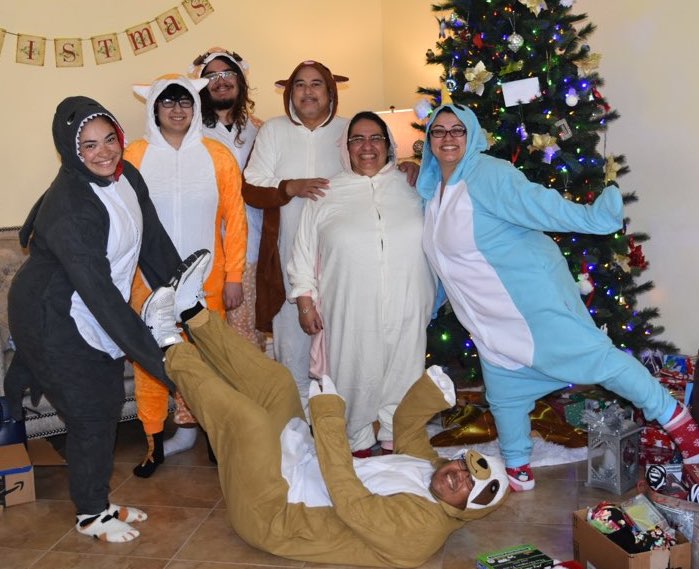





 This is what a mathematician looks like